

When a short-term rental business stops growing, the instinct is almost always the same: we need more doors.
But adding homes to a business that can't manage its current ones consistently doesn't solve the problem. It multiplies it.
Every missed maintenance charge, every hour spent fixing owner statements and every expense nobody sees until month-end gets repeated across a bigger portfolio. More revenue comes in, more work goes out, and not necessarily more profit stays.
That's why process isn't back-office busywork. It's how a management company protects its margin as it grows.
Sharon Keefe dug into this with Rachel Alday of Abode Luxury Rentals, Mark Kombrink of Host2Coast and Darren Carter of Topkey on Topkey's panel, How to Grow a Short-Term Rental Business Past 200+ Units.
Why More Doors Won't Fix It
At 50 homes, a few experienced people can cover for weak process. They know the owners, remember the properties and just know how things get done.
At 150 or 200, that knowledge stops transferring. More people touch the same home, more exceptions come up, and what worked through familiarity breaks down through volume.
The leaks show up in three places:
Revenue: work orders that get done but never billed to the owner.
Labor: owner statements that take days and an all-hands effort to prep.
Visibility: spend nobody can see until the month closes, when it's too late to act.
More homes aren't the problem. Adding them faster than your operation can absorb them is. Mark's advice from the panel: be far more selective about the homes you take on, and don't discount your service to win them.
Sometimes the best growth decision is to fix the business you already have.
Step 1: Name Your Core Processes
Every management company runs on a handful of core processes. Name them, agree on them as a leadership team, and give each one a single owner:
Homeowner acquisition: lead to signed management agreement.
Owner onboarding: signed agreement to a fully set up, photographed, priced and bookable home, with housekeeping and maintenance assigned.
Reservations and guest experience: inquiry to booking to check-out and review.
Housekeeping and turnovers: every clean, inspection and restock between stays.
Maintenance and work orders: report, dispatch, fix, bill.
Owner accounting: trust accounting, owner statements and payouts.
Owner retention: communication, reporting and renewals.
People: hiring, training and the right person in each seat.
Eight is plenty. If you have 25, you've listed tasks, not processes.
Step 2: Define Where Each Process Really Ends
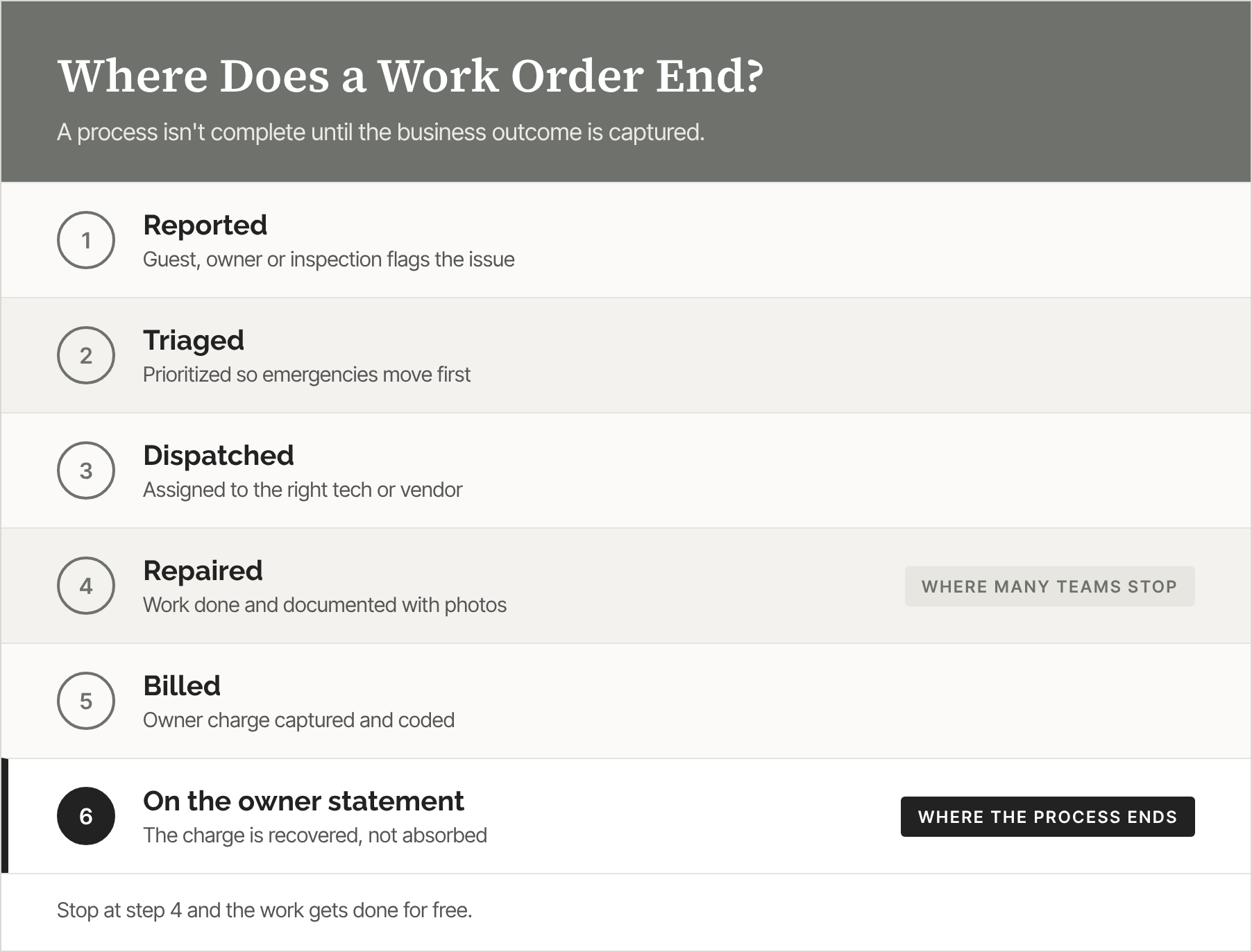
This is where most process work goes wrong. A process shouldn't end when the physical work is done. It should end when the business outcome is captured.
A work order isn't complete when the technician leaves. It's complete when the owner charge lands on the owner statement.
Skip that last step and you did the work for free.
A turnover isn't complete when the cleaner leaves. It's complete when the home passes inspection and is ready for the next guest. Onboarding isn't complete when the owner signs. It's complete when the home is bookable.
Define completion around the outcome, not the activity. Then document only the critical steps to get there, and cut any step that exists because "that's how we've always done it."
Owner accounting works the same way. Document how the month closes, who reconciles what and by when, and statements stop being an all-hands scramble. Clean trust accounting depends on it.
Step 3: Put Them Where the Team Works
A process in a binder doesn't get followed. Put each one inside the system your team already uses, whether that's your PMS, task management tool or a shared playbook.
Then retire the workarounds. Picture five systems to log into, a fifth of the staff using them, and Post-it notes still flying around the office. The software isn't the problem. Too many places to look is.
Step 4: Make Them Followed by Everyone
Sharon's question for every team: is your process company policy, or optional?
If it's optional, it isn't a process. Make it policy:
Train on it, including every new hire.
Hold people to it, the same way you'd hold them to a guest standard.
Build it around the team, not one person. Both operators run owner communication through one shared inbox, so relationships don't leave when a rep does. More in Owner Relations Make (or Break) Your Revenue Strategy.
The right people in the right seats matter here too. See how we approach team structure and organization.
Step 5: Measure Outcomes, Not Activity
You can't manage a process you can't see. But measuring activity isn't the same as measuring performance.
A maintenance team can close work orders fast while missing owner charges. An onboarding team can sign homes quickly and still take weeks to make them bookable.
The numbers need to show whether each process produces the result it's supposed to.
Start with one or two vacation rental KPIs per process, each with one owner. Add more only when you need them to diagnose a problem.
Homeowner acquisition: new agreements signed and net homes added.
Owner onboarding: days from signed agreement to bookable.
Reservations and revenue: occupancy, ADR, RevPAR and booking pace against last year. More on that side in our revenue management work.
Housekeeping: inspection pass rate and labor cost per home.
Maintenance: share of work orders completed on target, and share of billable work orders captured on owner statements.
Owner accounting: days from month-end to statements issued, and corrections per cycle.
Owner retention: the share of owners and homes under management at the start of the year that you still manage at the end.
Then watch two company-level numbers: management revenue per home and contribution margin per home. If revenue grows while margin per home falls, growth is hiding a leak.
Both operators brought housekeeping in-house and called it a major profit lever. Rachel credits written SOPs for making the switch without a dip in cleaning reviews.
That doesn't make in-house the better model. Labor utilization, turnover volume, quality control and scheduling decide whether it makes or loses money. You need the numbers to know.
Step 6: Keep the Rhythm
Processes drift. A steady rhythm keeps them honest:
Weekly: review the scorecard of eight to twelve numbers. Every off-track number gets a named issue, an owner and a next action.
Quarterly: pick three to five priorities, usually the processes behind your weakest numbers.
Annually: revisit each core process and update the documentation.
Budget for outside eyes, too. Both operators credit industry groups and peers outside their market for their biggest changes. Mark hired a consultant who made this year "night and day" compared with last.
And review your tools as you grow. What worked at 50 doors rarely holds as you scale, which is why we suggest revisiting your vendor stack every year.
Hear the Full Conversation
The panel gets tactical about scaling past the point where growth stalls: the tools, the tough calls and the operational non-negotiables. Watch the full Topkey panel on our Webinars & Podcasts page.
Adding homes is easy to measure. Building a company that handles them profitably is harder.
If growth has stalled, or the business is getting bigger without getting more profitable, the next step may not be another acquisition push. It may be finding the gaps that are costing you money. That's the work we help management companies do.
FAQs
Why do short-term rental businesses stop growing?
Usually because the processes that worked at 50 doors don't scale. Unbilled work orders, slow owner statements and spend nobody sees until month-end eat the margin that growth should create.
What are the core processes of a vacation rental management company?
Most run on about eight: homeowner acquisition, owner onboarding, reservations and guest experience, housekeeping and turnovers, maintenance and work orders, owner accounting, owner retention and people.
When is a vacation rental process complete?
When the business outcome is captured, not when the physical work is done. A work order is complete when the charge lands on the owner statement, and a turnover is complete when the home passes inspection.
What KPIs should a vacation rental management company track?
One or two per core process that measure outcomes, such as days to bookable, share of billable work orders captured, statement turnaround and owner retention. Add management revenue and contribution margin per home, and keep the leadership scorecard to eight to twelve numbers.