
Your Vacation Rental Marketing Plan Is Not a Solo Act

Planning a vacation rental marketing campaign often starts with the calendar: What campaigns are coming up? Where is content lacking? When is the next mass email going out? What website enhancements are scheduled? Which paid campaigns are already planned?
Those are necessary questions. But your vacation rental marketing plan only tells you what is planned. It doesn’t tell your team what is happening in the business right now, which audiences are showing demand, or where booking behavior may warrant a change in marketing priorities.
Revenue management brings a different perspective, looking at what the business is experiencing and where performance is heading.
Those signals include:
How bookings are pacing against forecast
Where occupancy is building
How ADR and RevPAR are performing
How far in advance different segments are booking
Which property types or markets are behaving differently
Whether current booking behavior follows historical patterns
Both teams are looking at the same business. They just aren’t always looking at it together. That is the opportunity.
Revenue management can provide the forward-looking context that helps marketing decide where to focus, when to act, and whether priorities need to change.
Start With What the Revenue Data Is Saying
Before marketing changes a campaign, it helps to understand what the forward-looking revenue review is actually showing.
Which segments are booking? At what ADR? How far in advance? Are certain property types behaving differently? How does current performance compare with forecast and historical patterns?
No single metric answers those questions. Together, the signals help revenue management distinguish between something that looks different and something that actually is different.
An Open Date Isn’t Automatically a Problem
A forward-looking number only becomes meaningful when there is something to compare it against.
Different markets and property types book differently. Some segments routinely book months in advance. Others make decisions much closer to arrival. Some seasons build steadily. Others experience a sharper booking curve.
Historical data provides that reference point. If a segment is booking at its typical pace, an open date may be completely normal. If that same segment is materially behind its historical curve, the signal is different.
“Open” and “underperforming” are not the same thing.
Without historical context, an open date can look like an opportunity that needs immediate attention. With that context, the team can determine whether the inventory actually warrants a change in marketing priority.
Timing matters, too. Email, paid media, SEO, social, and website merchandising all need time to reach an audience and influence a decision. Knowing where a segment sits in its normal booking cycle gives marketing a better basis for deciding when those efforts are most likely to matter.
Turn Revenue Insight Into a Marketing Decision
Revenue management should not hand marketing a list of empty dates and ask the team to fill them.
The useful handoff is the context behind the numbers:
What changed?
How significant is the change?
Which segments, markets, or property types are affected?
Is the change ahead of or behind forecast?
Does the pattern differ from historical behavior?
Marketing then brings its own expertise to a different question: Given what we’re seeing, should anything about the marketing plan change?
That change could involve when marketing acts, who it speaks to, what it says, where it appears, or whether it acts at all.
Where the Vacation Rental Marketing Plan Changes
Revenue insight does not automatically become a new campaign. It can change how marketing evaluates the plan already in place.
Campaign Timing
A segment is entering its normal booking window, but pickup is trailing the historical curve.
That doesn’t automatically mean marketing needs a new campaign. An already-planned email may need to move earlier, paid media may need to be weighted differently, or a planned communication may need to reach the audience while that segment is actively making travel decisions.
The timing change is grounded in the booking curve rather than simply the marketing calendar.
Marketing measures: CTR, conversion rate, CPA
Revenue measures: Pickup, booking pace, occupancy, forecast
Audience and Market Focus
One market may be pacing normally while another shows weaker forward performance. Revenue insight gives marketing a reason to look more closely at audience reach, spend, and messaging in that market.
The response could be a change in targeting, segmentation, creative, or allocation of existing budget.
Marketing measures: CPA, conversion rate, ROAS
Revenue measures: Occupancy, ADR, pickup, segment pace
Content and Messaging
Revenue data can also influence what marketing chooses to emphasize.
If a property type is entering an important booking period, or historical behavior points to a particular audience or travel need, that context can shape website content, email messaging, landing pages, social creative, or paid advertising.
Marketing measures: Engagement, CTR, time on page, booking conversion
Revenue measures: Pickup, booking pace, occupancy, ADR
Website and Merchandising
A meaningful shift for a market, property type, or travel period can prompt marketing to examine how that inventory is represented on the direct-booking website.
Is it easy to find? Is the relevant destination or property type being surfaced? Does the content match the audience being targeted? Is the booking path supporting conversion?
Marketing measures: Bounce rate, booking conversion, abandonment
Revenue measures: Pickup, pace, occupancy, ADR
Knowing When Not to Act
Revenue insight can be just as useful when it confirms that the existing marketing plan does not need to change.
If a segment is pacing normally against its historical curve, an open date doesn’t automatically justify more advertising. And if the issue is rate positioning, a minimum-stay restriction, or another revenue-management decision, more traffic won’t solve it.
In those cases, marketing may be better off maintaining its plan while revenue management addresses the underlying issue.
The goal isn’t more marketing activity. It’s more informed marketing activity.
Two Sets of KPIs. One Business.
Marketing and revenue management don’t need to report the same numbers, but they need to understand how their numbers connect.
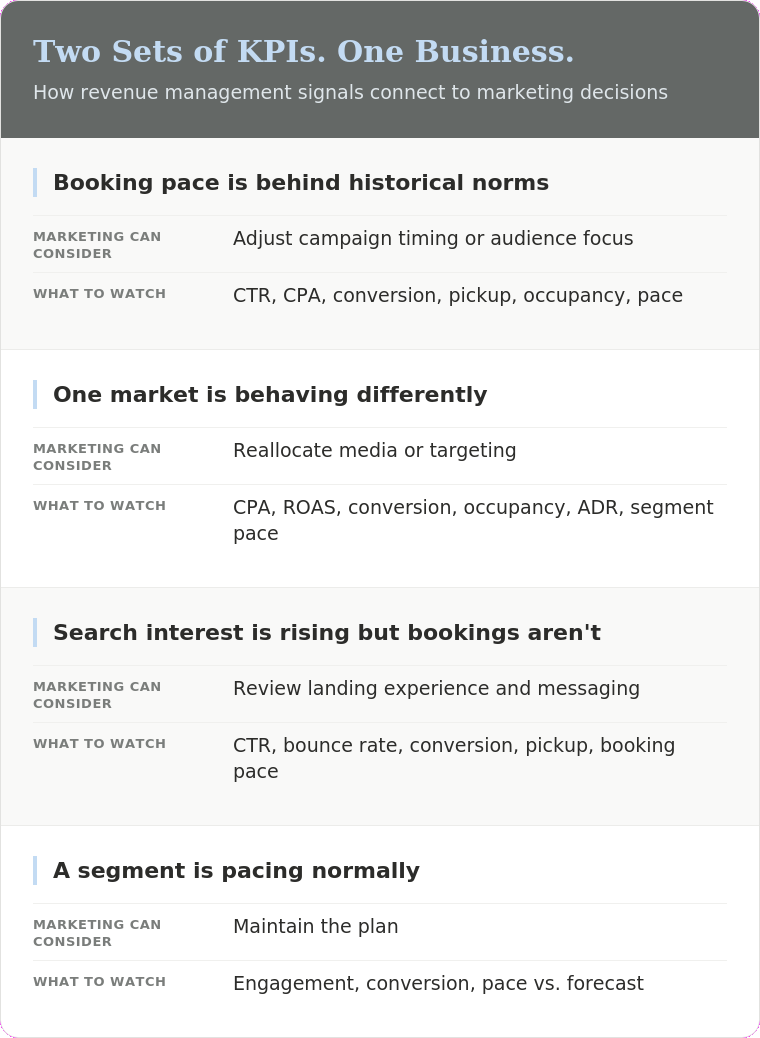
Marketing shouldn’t replace its KPIs with RevPAR, and revenue management shouldn’t judge a campaign by CTR. The value comes from looking at each team’s performance in the context of the other’s.
What This Looks Like in Practice
The connection becomes clearer when the revenue insight and marketing consideration are placed side by side.
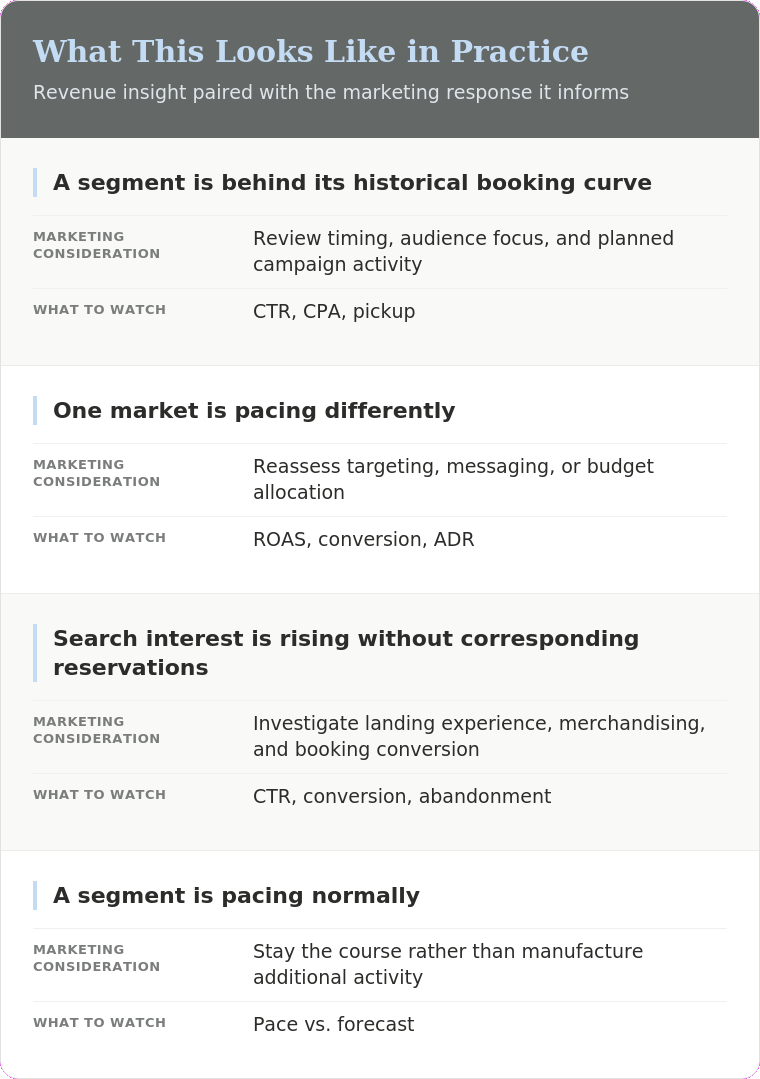
These aren’t formulas for turning revenue data into campaigns. They’re inputs that give marketing a clearer view of what the business is experiencing and a better basis for deciding what to do next.
Then Close the Loop
The process doesn’t end when marketing changes a campaign or publishes new content.
At the next revenue review, the teams can ask three questions:
Did the business move?
Did the marketing response perform?
Did the two connect?
Sometimes the answer will be yes. Sometimes the results will show that the original issue wasn’t marketing at all.
Both outcomes are useful. They give revenue management more context for the next forward-looking review and give marketing a clearer understanding of how its activity relates to the business trends it is trying to influence.
That is a feedback loop, not two separate reporting processes.
One Business. Two Disciplines.
Revenue management and marketing don’t need to do the same job. Revenue management brings the forward-looking business context. Marketing turns that context into audience, content, campaign, website, and channel decisions.
That’s where the RealTech and VRM Advocate partnership adds value. VRM Advocate brings the revenue perspective through its Monthly Revenue Management Meetings, while RealTech applies that insight across direct-booking websites, SEO, content, paid media, and digital marketing for vacation rentals.
The result is a more connected planning process, grounded in what the business is actually seeing. Better marketing decisions start with a better understanding of the business.
Where Does Your Next Move Sit?
If the issue is pacing, rate positioning, or restrictions, it's a revenue conversation. If it's reach, traffic, or how your inventory is presented, it's a marketing one.
VRM Advocate · RealTech Webmasters